
All Posts By

Southern Irrigation

Increase yields SDI Banner

INCREASE YIELD PERFORMANCE WITH SUBSURFACE DRIP IRRIGATION

By SDI

Reduce operating costs and produce more crops with the most efficient farm irrigation system

The average farmer faces many obstacles when trying to grow a successful and reliable crop from their land. Challenges such as rolling topography, odd-shaped fields and elevation changes, unreliable weather patterns, excessive water waste, and nutrient leaching are too familiar. The amount of fertilizer spent trying to add nutrients back into the soil can be up to 30-40% of operating costs! Finding an irrigation method that efficiently solves all these problems can seem impossible. Over the past four decades, drip irrigation has evolved and has proven itself superior to other irrigation methods. Unlike systems with a saturated water flow (such as sprinklers), drip irrigation systems emit low volumes of water and nutrients directly into the soil in a uniform and precise way to every plant across the entire field.

SDI CAN INCREASE YIELDS UP TO 50%

As a result, drip irrigation increases crop production, yield, quality, and accelerates maturity. All while using considerably less water than other irrigation methods such as sprinkler, centre pivot, lateral hose, etc. As drip irrigation became more popular, different types of drip emitters and methods were developed. Today, the most advanced and proven method is called “subsurface drip irrigation”.

Subsurface drip irrigation (SDI) is an evolution of conventional irrigation systems and provides the grower with many added benefits to surface drip methods. These include eliminating surface evaporation, preventing weed germination, eliminating herbicide washout, reducing crops stress, and more.
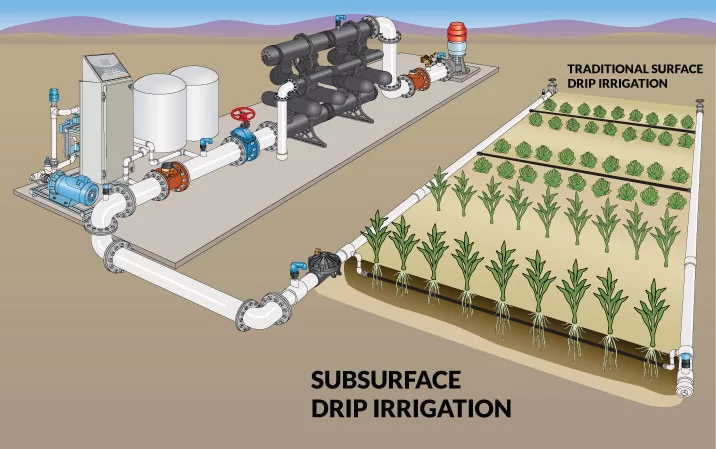
Row crop layout SDI

Interest in SDI has grown rapidly in North America within the last 25 years, as innovations from Netafim have made subsurface drip irrigation the most advanced, modern method for irrigating agriculture crops. SDI is used especially by growers in areas where water is scarce or where increased efficiencies and higher quality crops are desired.

Refinements to the installation procedure, lower overall costs, and enhanced product qualities have made SDI quite cost-effective. Because of it’s high efficiency and adaptability to tough growing conditions, SDI is now being used throughout the world on a wide range of grain, forage, and fiber crops including alfalfa, canola, corn, cotton, soybeans, and sugarcane.

What is Subsurface Drip Irrigation?

SDI is where the drip line is buried under the soil surface as opposed to laying on the surface. SDI consists of flexible polyethylene (PE) tubing with emitters welded to its inside wall. These drip lines are permanently buried in the soil in rows 30-60” apart, at a depth of 8-16”, depending on the soil type and the plant’s root structure.

Water is pumped, under low pressure, through a filtering system to the drip lines. These PE driplines are available in many different configurations to meet your unique crop, water, and soil conditions. The drip emitters slowly release very specific and uniform amounts of water directly into the root zone of the plant.

This controlled and precise method of emitting water allows the plant to uptake most of the water that is sent into the system. The water travels through the soil and into the root zone of the plant, pulled by capillary action.
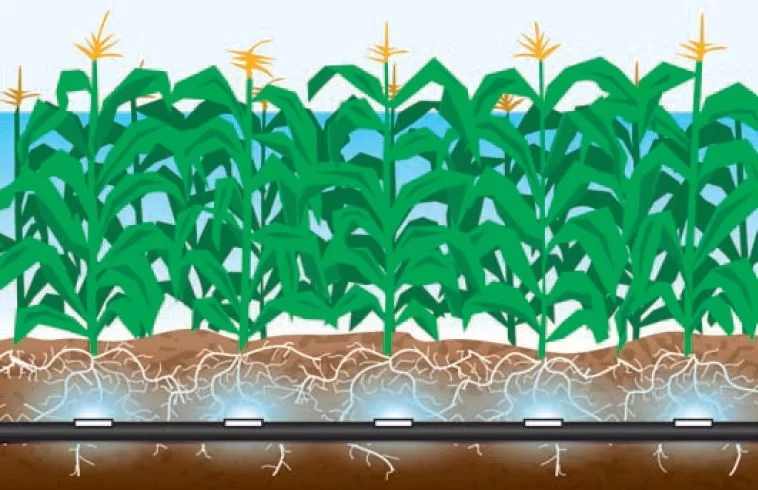
subsurface drip irrigation corn

Maintain Optimal Soil Moisture with an Effective Root Management Tool

Subsurface drip irrigation is not just an irrigation system; it is also a root zone management tool. All plants transpire, and the soil also loses water through evaporation, which will vary depending on environmental conditions such as temperature, humidity, and wind. Together, these losses are called evapotranspiration (ET).

Plants perform at their best if soil moisture is at 40-80% (100% being the saturation point, and 20% being the wilting point). Therefore, if soil moisture can be maintained within this range, a crop will have more vitality, produce more and better fruit, and experience very little stress.

Further, for a plant to take up nutrients from the soil, oxygen is required. The goal then, is to ensure optimal moisture in the soil and optimal air concentration, so that the yield and quality of the crops is maximized while shortening growth cycles. Since we are not able to control the atmosphere, we must control the soil.

“SDI USES 20-40% LESS WATER THAN AN
EFFICIENT SPRINKLER SYSTEM OR CENTER PIVOT”

Flood irrigation, and many sprinkler systems, saturate the soil. This means the soil’s pores are full of water and most of the air is pushed out, effectively suffocating the plants and making it unable to generate the energy to take in nutrients.

In an SDI system it is never necessary to saturate the soil, and it allows you to react quickly to various environmental conditions – providing the optimum combination of moist soil and oxygen concentration. Sometimes stressing a plant (for example, to trigger flowering or ripening) is a needed management technique. Subsurface drip irrigation allows this technique to be accomplished quicker and with greater control.

Reduce Water and Energy Usage, and Environmental Impact

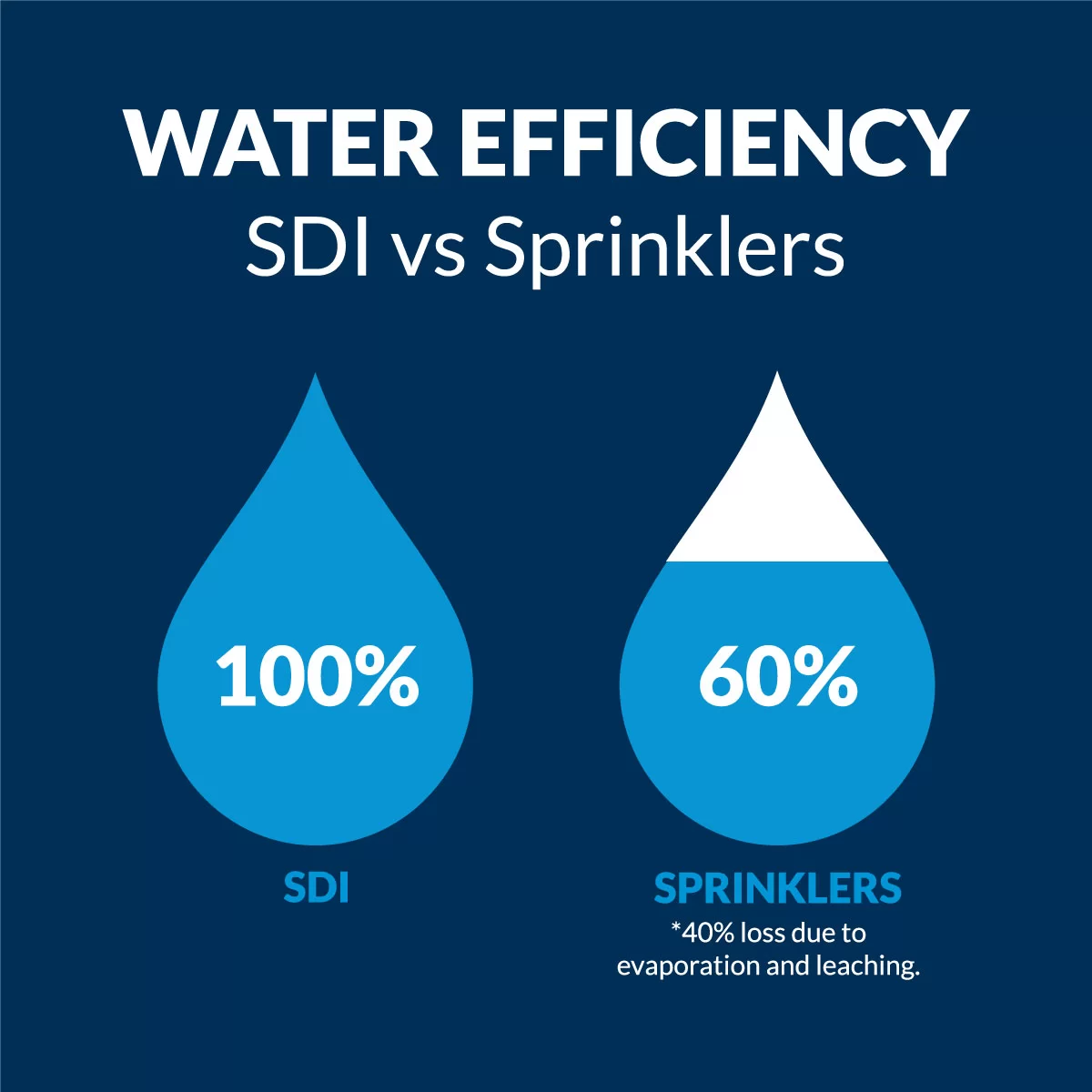
Applying water onto the surface in hot dry or windy conditions results in 20-40% evaporation before the water even enters the soil.  Although cost effective, most conventional sprinkler systems apply water at a rate where the soil is unable to absorb it fast enough, resulting in run-off, erosion, and saturation.  Many farmers have switched to SDI to use its significant water savings. SDI uses 20-40% less water than an efficient sprinkler system or center pivot, and up to 60% less water than conventional flood irrigation methods.  Because an SDI system operates at lower pressures, energy costs can easily be as much as 60% less than a sprinkler system. SDI doesn’t lose any water to evaporation, utilizing almost 100% of the water it emits. 
Increase Fertigation Effectiveness and Reduce Fertilizer Needs

A concentrated root zone has a much higher density of roots in any given unit of soil and the effectiveness of the fertigation supplied to the soil is much greater. With an SDI system, fertilizer can be applied to the root zone when it will be most beneficial – resulting in greater use efficiencies, better crop performance, and improved crop yields.

The lower application rate of SDI also prevents the leaching of minerals from the root zone into the groundwater and prevents run-off water which can carry pesticides and fertilizers. Fertilizer requirements can be reduced by as much as 25-40%.  Since the system is underground, fertigation can also continue without interruption and multiple operations can take place, simultaneously.

Create a More Natural Growing Environment with Less Herbicides and Pesticides

With the use of subsurface drip irrigation, the wetted surface is virtually eliminated. The drier ground minimizes weed development. This reduces tilling and spraying, which ultimately reduces costs for pesticides and herbicides and provides a more natural growing environment. There is no need to damage your crops for fertilizer applications, as the fertilizer (and in some cases herbicides and pesticides) can be applied directly through the drip system. There are no pivot tracks, and machine work can easily be done in straight rows.
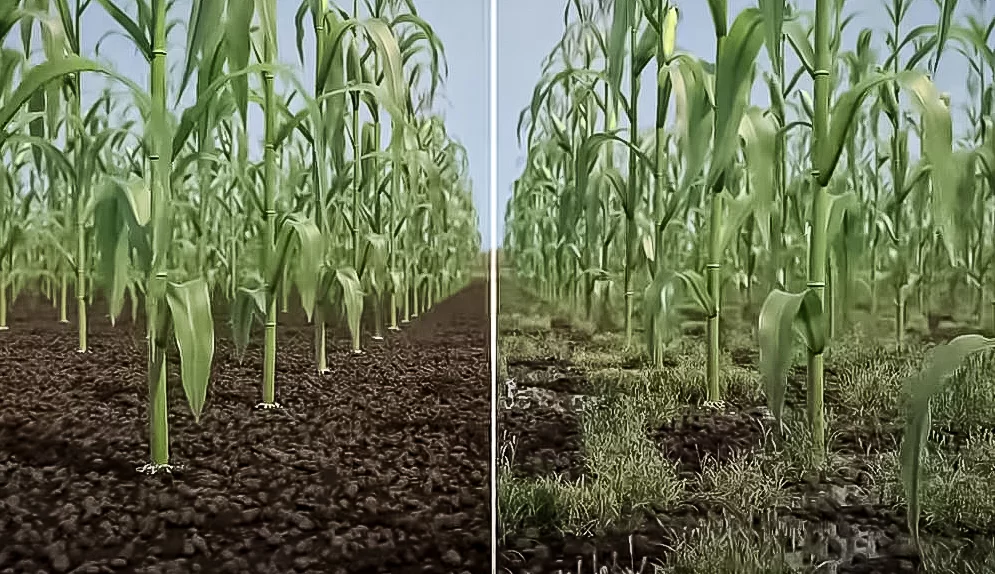
Side-by-side corn field seedlings: left panel weed-free, dark soil; right panel with weeds between rows.

Adapt to Any Field, Soil Type or Topography

Central to the SDI advantage is its adaptability to any field shape, size, soil types, and topography. SDI is especially versatile with difficult terrain, whether it’s undulated, sloped, irregularly shaped, or holds meandering rivers, streams or canals. Growers find themselves switching to SDI, as it covers other areas of the field that older systems cannot, increasing their irrigable acreage.

NOTE: It is important to have your system designed by experienced professionals who understand the numerous variables that must be considered when customizing your SDI system to your specific field type, or your system may not perform as intended.

Increase Recurring Revenue with Better Product Quality and Higher Yields

SDI reduces deep leaching of plant nutrients and maximizes the quality, texture and taste of your products, improving the return rate of your customers. This provides your business with a more predictable and consistent revenue stream, higher customer lifetime value and allows you to plan for more growth opportunities.

Proven Yield Results with Independent Case Studies

On average, crop yields can be increased between 10 to 50% using SDI. For example, the average yield for seed alfalfa is around 500lbs per acre. One of Southern Irrigation’s test projects yielded up to 900lbs — an 80% yield increase! Another project with seed canola resulted in a 20% increase in yield compared to an adjacent plot planting under pivot irrigation. These positive results were due to SDI’s proper moisture application and timely nutrient application.

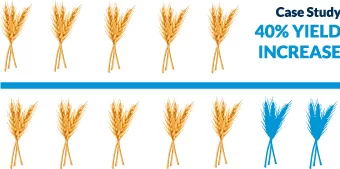
A case study was done in Southern Colorado, where a grower had adopted the SDI method on his field of 171 acres for a variety of crops, including melons, onions, peppers, tomatoes, corn, alfalfa, beans, and small grains. He chose an SDI system as it allows for more control of water and nutrient application, as well as other farming operations. He had hoped to realize improved crop yields and quality, reduced fertilizer application, and a reduction in disease and pest problems.

He could not have been more pleased with the results using subsurface drip irrigation and his water savings have been impressive. For example, 3 to 4 acre-ft of water was required for each acre of melons using flood irrigation. With SDI, the grower now uses just 1 acre-ft per acre. Fertilizer applications have been reduced by 30% and crop yields have improved by at least 40% across the board. The quality of the produce has also improved, especially the melon crops.
case study SDI yield increase diagram

Although this grower originally set out to save water, in the end he found saving water can result in many other benefits including increased yields, higher quality crops, lower fertilizer input, and less environmental impact. In short, his family farming operation is healthier and is better situated to compete down the road with the implementation of SDI technology. (Eckas, 2005)

Another study was done in China for winter wheat crops after the North China Plain faced a water deficit. Lysimeter experiments (measuring the amount of actual evapotranspiration which is released by plants) were conducted under different irrigation methods – flood, surface drip and subsurface drip irrigation.

Subsurface drip irrigation reduced evapotranspiration by 26% compared to flood irrigation, and 15% compared to surface drip irrigation, with significant grain yield and biomass formation due to decreased evaporation losses. Grain yield, yield components, and above ground biomass were similar in subsurface drip and flood irrigation. However, these biomass parameters were lower with surface drip irrigation.

Subsurface drip irrigation also increased the crop water productivity by 25% and irrigation water productivity by 20% compared to flood irrigation. The subsurface irrigated plants showed an increase in net photosynthesis by approximately 10% , higher intrinsic water use efficiency (~36%), lower transpiration rate (~22%), and saved 80 mm of water compared to flood irrigation. (Umair, 2019)

The Southern Irrigation Advantage

Southern Irrigation is a pioneer in the drip irrigation industry, selling drip irrigation in Canada for over 37 years. We are the largest agricultural irrigation supplier in Canada. Because of this, we have the resources to design and install irrigation systems faster, while maintaining quality installations we are proud to stand behind.

Southern Irrigation has the most experience with SDI in Canada on a variety of crops including hemp, canola, seed alfalfa, corn, and more. We have built the expertise needed to work with Canada’s challenging climates and its various types of terrain.  Our past projects have been opportunities to test and refine our procedures to offer our customers systems of the highest quality and efficiency. We do this by monitoring system performance, crop results, and taking customer feedback.

Netafim, the inventor of the plastic drip emitter in 1950, is the global leader with advanced, high quality drip irrigation products and components. As modern drip irrigation methods have evolved, producers now depend on Netafim’s drip irrigation advancements to help them improve yields while also reducing water, energy, labor, and nutrient costs. Southern Irrigation works closely with Netafim to make continuous improvements and have established ourselves as the leader in Canada’s Ag-irrigation industry.

Excellent irrigation design, installation, maintenance, and advice combined with Netafim’s advanced drip irrigation products, ensures a reliable SDI system that provides great efficiency and return on investment.

References

Eckas, W. E, 2005, Case Study: Subsurface Drip Irrigation in Southeastern Colorado, July 3, 2020 <https://www.irrigation.org/IA/FileUploads/IA/Resources/TechnicalPapers/2005/2005IrrigationShowTechnicalPapers.pdf page 92>

Umair M, Hussain T, Jiang H, Ahmad A, Yao J, Qi Y, Zhang Y, Min L, Shen Y. Water-Saving Potential of Subsurface Drip Irrigation For Winter Wheat. Sustainability. 2019; 11(10):2978.

2020. 2020 Cost Of Production Crops. [ebook] Manitoba Agriculture and Resource Development, p.2. Available at: <https://www.gov.mb.ca/agriculture/farm-management/production-economics/pubs/cop-crop-production.pdf> [Accessed 22 July 2020].
Learn More About SDI

SDI Portfolio
Contact Us
SDI

SUBSURFACE DRIP IRRIGATION PROJECT: VALK LAND AND CATTLE LTD

By SDI

SUBSURFACE DRIP IRRIGATION PROJECT

Valk Land and Cattle Ltd.

Valk Land and Cattle have worked with Southern Irrigation to implement a 625-acre subsurface drip irrigation system, the largest in Canada. The system was ready in 2021, during Alberta’s hottest year in history.

TRANSCRIPT

“I’m Lawrence Vandervalk; I represent Valk Land and Cattle, co-owners with my wife, Sherry.

I would recommend SDI to anyone who was interested in the future of irrigation. 

Our project was 625 acres, apparently, the largest single unit of irrigation in North America, being a 625-acre field in one unit.

We had Southern Irrigation install our system. We walked into their office one day and asked if they had anything to do with drip. They informed me that they did, and the rest is history.

After last year we realized the importance of drip, the importance of irrigation. I have no pivots; I never irrigated previously. 

So, after seeing what we did last year, what was the result of the work of SDI, we decided to go ahead with an additional quarter. So, currently, we are plowing in another 160 acres.

The dryland this year would have been a disaster, we got less than 4″ of rain, so there wouldn’t have been much of a crop. Hay probably would not have been worth cutting—yields on the winter wheat, probably less than 20.

Southern Irrigation was great; they gave me lots of support. I really appreciated our 6:30 Monday morning meetings out in the field.

We did soil moisture probing. To our surprise, we discovered that even in the extreme heat that we were getting and the lack of moisture, that we really only needed in total 11.5″, and we stopped irrigating on August 12th. The profile was basically empty when we started, and we finished the season with a full profile.

SDI, there’s a nickname for it; it’s called 30/30/30. 30% less water, 30% less operating costs, 30% more productivity. We started with an empty profile, 11.5″, and we had no problems keeping up.

The people, their work ethic, hands down, bar none, number 1.

I think every dollar that you spend towards irrigation, no matter what system you use, is going to be a big benefit in Southern Alberta. It certainly was for me.

We managed to have the system running in the dryest year in history, and I originally thought, this is a home run. I think it was a grand slam.”

~ Lawrence Vandervalk, co-owner of Valk Land and Cattle Ltd.

PROCESS VIDEOS OF VALK LAND AND CATTLE PROJECT

Planning and Design
Plowing in Dripline
Trenching
Pump House
septic tank cover open

Plastic vs. Concrete Septic Tanks: Which Is Right for Your Property?

By Septic Supplies

DE-MISTIFY SEWAGE TANKS FOR YOUR ACREAGE OR FARM

A Common Septic System Situation

It was the first time building his own house. Eric Clark had just bought 2 acres on the outskirts of town, where he planned on building a 3-bedroom home for him and his family.

Eric chose everything he thought he needed for his new home.

The contractors were hired and he was ready to see construction begin. But when Eric was asked whether he wanted a plastic septic tank or a concrete septic tank, he froze.

Eric has always lived in the city, he never thought about septic tanks, he didn’t even know there were different types. Luckily, his contractors caught on to Eric’s confusion and answered his biggest questions…. What is a septic tank? And what’s the difference between plastic and concrete?

WHAT IS A SEPTIC TANK AND HOW DOES IT WORK?

A septic tank is an essential underground container designed for wastewater treatment. Constructed from materials such as concrete, polyethylene, fiberglass, or steel, these tanks enable natural bacterial processes to break down solids and organic matter, ensuring efficient sewage treatment and environmental safety.”

Septic tanks are especially crucial in places where centralized sewage treatment isn’t an option.

These buried tanks have a big job: they’re the cleanup crew for all the home and business wastewater. This includes dirty ‘grey water’ (showers, bathtubs, whirlpool tubs, washing machines, dishwashers and bathroom sinks) and ‘black water’ (toilets and kitchen sinks.)

Through a natural separation and biological breakdown process, septic tanks help remove solid waste and contaminants from sewage, allowing for the safe release of treated effluent into the soil.

Inside the tank, heavy solids sink to the bottom, forming a layer of sludge, while grease floats on top as scum. The in-between liquid, called effluent, gets broken down by bacteria. Once it’s somewhat cleaned up, the effluent heads out to a drain field or leach field, where it seeps into the soil, undergoing further purification.

So, septic tanks might be out of sight, but they’re definitely not out of importance – they play a vital role in keeping our properties and the land around them healthy and happy!

septic tank system diagram

Plastic vs. Concrete Septic Tanks

There are two popular types of septic tanks: plastic and concrete.

Plastic tanks tend to be more affordable and quicker to install. For these reasons, they tend to be more popular with homeowners and farms. However, they may not be as durable as concrete tanks and could be susceptible to damage from heavy machinery or shifting soil.

On the other hand, concrete septic tanks are less likely to be damaged and can withstand harsh environmental conditions. But, they are heavier, making installation more labour-intensive, and may require special equipment for transport which means higher costs to install.

Stacks of turquoise plastic septic tanks on a lot (left) and a green underground septic tank with a white inlet pipe on a concrete pad (right).

What to Consider When Choosing a Septic Tank

When it comes to picking the perfect septic tank, whether it’s for your home, business, or farm, it’s important to seek professional advice beforehand. It’s recommended to speak with a registered onsite wastewater practitioner or a local septic system professional to ensure that your choices align with the specific needs of your property and local regulations.

Ultimately, the choice between plastic and concrete septic tanks should consider factors like the following:

Budget

Determine cost for the entire septic system project, including tank selection, labour and ongoing maintenance.

Wastewater Volume

Assess the average daily wastewater flow in your household or property to determine the required tank size.

Soil and Site Conditions

Evaluate the soil percolation rate, groundwater level, available space, site topography, and any environmental considerations to inform system design.

Regulations and Permits

Understand local regulations, including setback requirements and permitting processes.

Installation Cost

Factor in the budget needed for tank installation, removal and disposal of the old septic tank (if necessary), including excavation, labour, and equipment.

Long-Term Maintenance

Assess the expected maintenance needs and cost for the chosen tank material, including regular inspections, repairs, and pumping.

Advantages of Plastic Septic Tanks

Lightweight

One of the standout benefits of plastic septic tanks is their lightweight nature. Compared to their concrete counterparts, plastic tanks are significantly easier to transport and manoeuvre into place during installation. This not only saves on transportation costs but also reduces the labour and equipment required for placement.

Cost-Efficiency

Plastic septic tanks are often the more budget-friendly option. Their lower initial cost, combined with reduced installation expenses, make them a cost-effective choice for homeowners and businesses.

Ease of Installation

The lightweight nature of plastic tanks makes them easier and faster to install. This speeds up the overall installation process, reducing labour costs and the disruption experienced by property owners.

Easy Plumbing

Plastic septic tanks often come with pre-installed inlet and outlet fittings, streamlining the connection to plumbing systems and reducing the complexity of plumbing work during installation.

Disadvantages of Plastic Septic Tanks

Shallower Burial Depth

Plastic septic tanks are typically buried at a shallower depth, often limited to around 4 feet below the ground surface. This depth may not provide as much protection against external factors like freezing temperatures or heavy vehicle traffic.

Limited Lifespan

Plastic septic tanks last 30 years or more, but in comparison to concrete tanks, they last a little shorter.

Maintenance and Cost for Plastic Tanks

Plastic tanks may need more check-ups because they’re prone to wearing out. Fixing them usually costs less, but when you add up the maintenance over time, it might end up being pretty close to what you’d spend on concrete tanks.

Excavation trench with a large black underground tank being installed, a backhoe nearby, and soil piled around the tank.

Advantages of Concrete Septic Tanks

Long-Lasting Durability

Concrete septic tanks are known for their exceptional strength and durability. They can withstand heavy loads, making them a good choice for places like driveways and parking lots.

Stable Underground Placement

Due to their substantial weight and density, concrete tanks are less prone to floating or shifting within the ground. This ensures their stability over time, reducing the risk of damage or misalignment.

Disadvantages of Concrete Septic Tanks

Heavy and Requires Special Equipment

Because concrete septic tanks are made of solid material, they often require the use of heavy machinery like cranes or specialized equipment during installation. That can bump up the labour costs, and it might not work in places with tight spaces.

Limited Size Options

Concrete tanks may not be your go-to choice if you need something big or with a unique design, They have limitations, and it might not fit the bill for specialized or larger tank needs.

Maintenance and Cost for Concrete Tanks

Concrete tanks may not be your go-to choice if you need something big or with a unique design, They have limitations, and it might not fit the bill for specialized or larger tank needs.

Construction site with large concrete cylindrical pipes and round access rings on a gravel lot, unfinished houses in the background.

The Importance of Choosing the Right Septic Tank for the Right Application

Using the right septic tank for the right application is important for effective wastewater management and environmental protection.

Septic tanks are not one-size-fits-all; they should be chosen based on factors like the property size, soil type, local regulations, and the expected wastewater load.

Picking the right septic tank size and design is a smart move. It keeps your wastewater system running smoothly and avoids problems like overloads, pollution, and big repair bills.

Choosing the wrong tank? That can spell trouble with your local authorities, and harm the environment.

Make sure you pick the right tank – it’s not just good for you but also for the environment.

ROWP’s: Your Key to Choosing the Perfect Septic Solution

It’s a good idea to consult an Registered Onsite Wastewater Practitioner (ROWP) who can check your specific situation and provide personalized advice that’s right for your property. Their experience can save you from costly mistakes, save time and make sure your septic tank keeps working well for years.

Must-Have Products to Support your Septic Tank

Risers

These are vertical extensions used to raise access points in concrete septic tanks, allowing for easier inspection and maintenance.

Effluent Filters

Effluent filters are crucial components that help remove solids from the wastewater before it leaves the septic tank, improving the overall system’s efficiency and preventing clogs in downstream components.

Pump Chambers

These are specialized compartments within septic systems designed to house the pump equipment responsible for moving effluent to its designated treatment area.

Control Panels

SJE and Aquaworx panels are electrical control panels used to monitor and manage various aspects of a septic system, such as pump operation and alarm systems, ensuring smooth and efficient performance.

Carbon Filters

These are filtration components often employed to reduce odors in septic systems by adsorbing and neutralizing volatile compounds within the wastewater.

Adapters

Adapters are connectors and fittings used to join various components of a septic system, ensuring proper integration and functionality.

All of these products help keep septic systems running smoothly and make them last longer while being kind to the environment.

View all of our septic products in our extensive catalogue.

The Pros and Cons

n the world of septic tanks, plastic and concrete are two popular choices, each with its own set of advantages and drawbacks.

Plastic septic tanks are lighter, budget-friendly, and resistant to corrosion, while concrete tanks offer unmatched durability and stability. However, the decision should always be tailored to your unique needs and site conditions.

Contact us with any questions. Read more about septic tanks.

Sources:

  • Infiltrator – Decentralized Wastewater Infrastructure: Challenges and Opportunities
  • Infiltrator – The Science Behind the Strength of Infiltrator Chambers and Tanks
  • Government of British Columbia – How to Find a Septic Tank
  • United States Environmental Protection Agency – How Septic Systems Work
  • Bio-Sol – Septic Tanks Explained | The Resource For Canadian Homeowners In 2023
  • Science Direct – Septic Tank- An Overview